
How to Prepare a Technical Inquiry for Industrial Grinding Machines | Weizhihao
Learn to draft precise technical inquiries for industrial grinding machines. Ensure accurate quotes and specifications from suppliers for optimal procurement.

How to Prepare a Technical Inquiry for Industrial Grinding Machines
For B2B buyers, importers, and factory purchasing teams, acquiring industrial grinding machines represents a significant capital investment. A vague or incomplete inquiry often leads to inaccurate quotations, specification mismatches, and project delays. Preparing a comprehensive technical inquiry is the critical first step toward a successful procurement process, ensuring you receive quotes that precisely match your production requirements and technical environment. This guide provides a structured framework for drafting effective inquiries for various industrial grinding machines.
Why a Detailed Technical Inquiry Matters
In the industrial machinery market, suppliers cannot provide accurate pricing or confirm machine suitability without specific details. A well-structured inquiry demonstrates professionalism, streamlines communication, and protects your interests. It minimizes the risk of receiving a machine that is incompatible with your existing workflow, material types, or workshop space, ultimately saving time and reducing procurement risks.
Core Components of Your Grinding Machine Inquiry
A technical inquiry should be a clear, organized document that answers a supplier’s key questions upfront. Focus on providing concrete data rather than general descriptions.
1. Machine Type and Primary Application
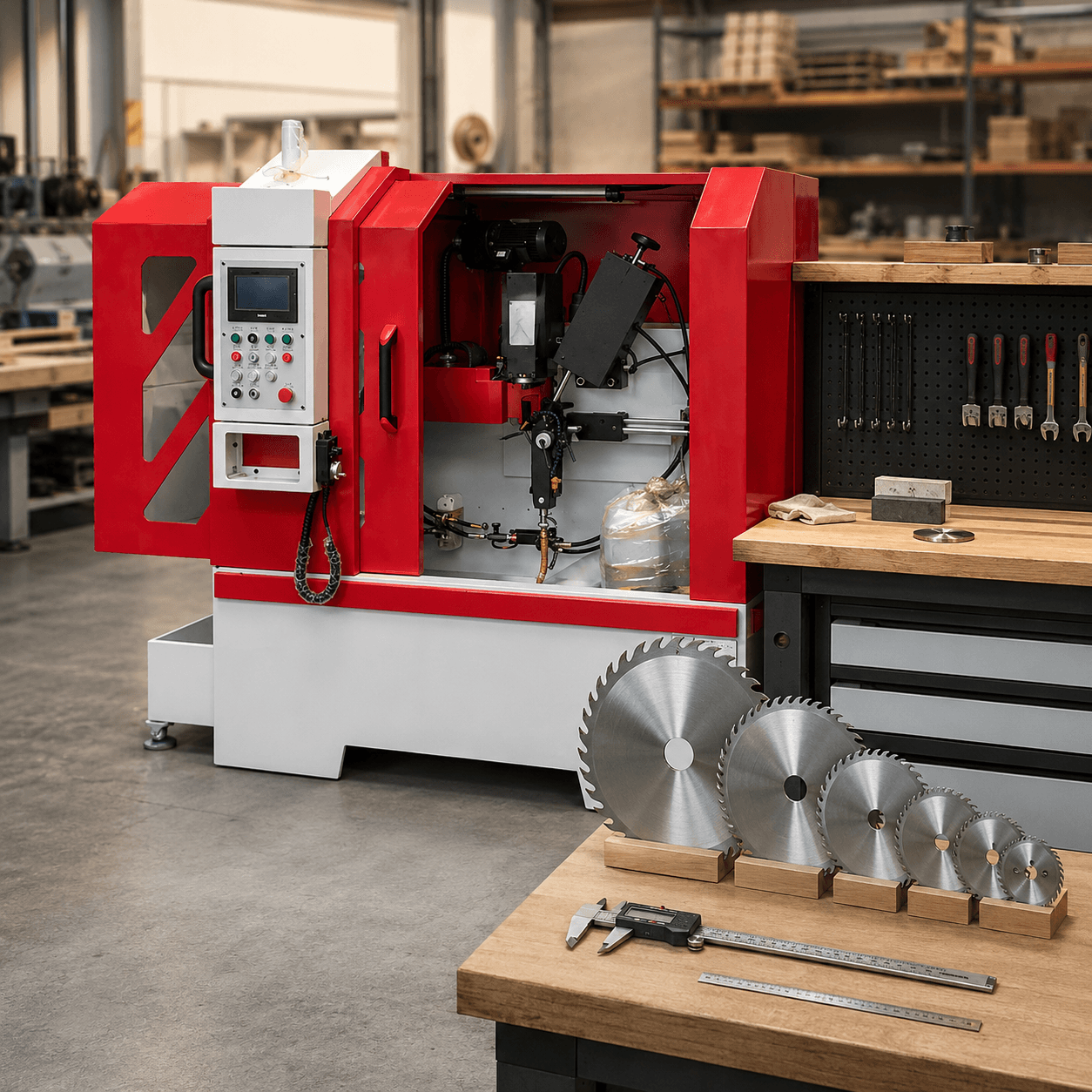
Clearly state the type of grinder you need and its intended use. Are you looking for a saw blade grinder for resharpening circular blades, a straight knife grinder for wood planer knives, or a universal tool grinder for complex tooling? Specify the primary material (e.g., carbide-tipped TCT saw blades, HSS planer knives, milling cutters) and the operations required (primary grinding, resharpening, finishing).
2. Required Technical Specifications
This is the heart of your inquiry. Provide measurable specifications:
- Workpiece Dimensions: Maximum and minimum length, width, diameter, and thickness of the tools or blades to be ground.
- Geometric Parameters: Required angles (clearance angle, rake angle, relief angle), tolerances, and surface finish requirements.
- Machine Capacity: Required motor power, spindle speed range, and table travel dimensions.
3. Production and Operational Requirements
Define your operational needs to ensure the machine fits your production flow:
- Duty Cycle: Expected daily operating hours and production volume (e.g., blades per shift).
- Automation Level: Preference for manual, semi-automatic, or fully CNC-controlled systems.
- Material Handling: Requirements for loading/unloading systems or integration with existing conveyor lines.
4. Facility and Compatibility Details
Help suppliers assess installation feasibility:
- Power Supply: Specify voltage, phase, and frequency (e.g., 380V/3-phase/50Hz).
- Space Constraints: Provide available floor space dimensions and any height restrictions.
- Existing Equipment: Mention any brands or models of current machinery for compatibility checks.
Supporting Documents to Include
Attach drawings, sketches, or samples of the tools you need to grind. Photos of your workshop layout or the current machines being replaced can also provide valuable context. If you have specific production targets or efficiency goals, include them as benchmarks.
Sending Your Inquiry to Weizhihao Machinery
With a complete technical package, you are ready to engage suppliers. A detailed inquiry allows our engineering team at Weizhihao Machinery to provide a precise quotation, confirm machine suitability, and offer informed recommendations, including options for different types of blade grinding machines. This collaborative approach ensures the proposed solution is engineered for your specific application.
FAQ: Common Questions About Technical Inquiries
FAQ: What is the most common mistake in a grinding machine inquiry?
The most frequent error is providing only a general description of the desired machine without specific workpiece dimensions or production goals. This forces suppliers to guess, leading to quotes for machines that may be over-specified or, more commonly, under-powered for your actual needs.
FAQ: Should I send a sample tool with my inquiry?
If possible, yes. Providing a physical sample is highly valuable. It allows the supplier’s engineers to verify the grinding process, assess material hardness, and confirm achievable tolerances. This can prevent significant misunderstandings before purchase.
FAQ: How long should a technical inquiry document be?
Quality over quantity. A concise, one-to-two-page document that covers the core components listed above is ideal. The goal is clarity, not volume. Use bullet points and clear headings to make it easy for the supplier to extract the necessary data.
FAQ: Can I inquire about multiple machine types at once?
Yes, but it is best to submit separate inquiry sheets for each distinct machine type (e.g., one for a circular saw blade grinder and another for a straight knife grinder). This prevents confusion and allows the supplier to assign the appropriate technical specialist to each request.
Ready to Get a Precise Quote?
A prepared buyer is a powerful buyer. Taking the time to compile a detailed technical inquiry is an investment that pays off in accurate pricing, smooth communication, and ultimately, the delivery of the right industrial grinding machine for your operation. If you are planning a new acquisition or upgrade, use this framework to structure your requirements.
Submit your detailed technical inquiry to our sales engineering team today for a tailored proposal and expert consultation on your grinding machine project.
