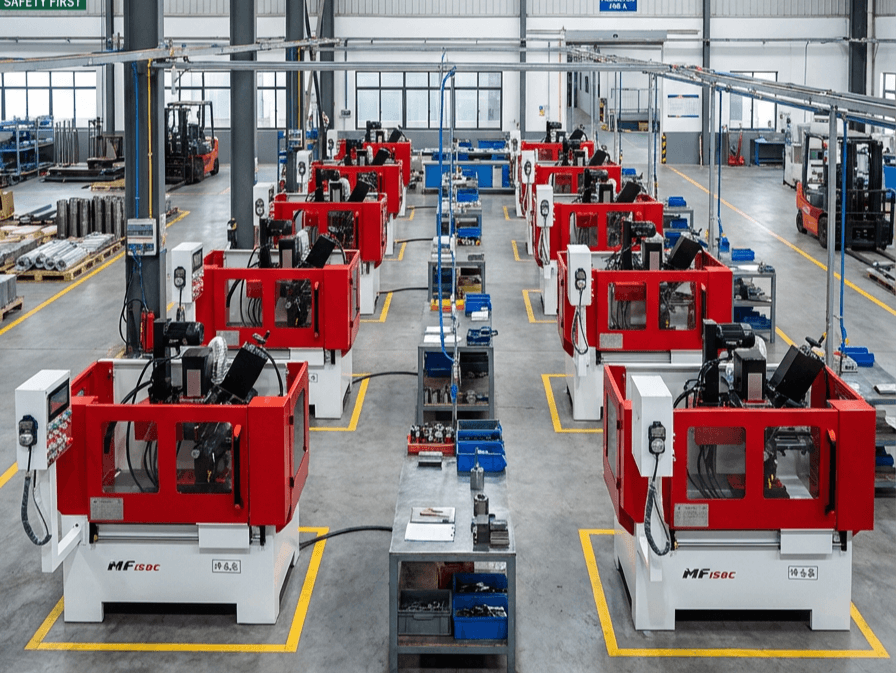
TCT Saw Blade Grinder: B2B Buyer’s Guide

QQuick Answer: A TCT saw blade grinder restores carbide tips on circular saw blades. As a result, it extends blade life by 5-7 cycles and cuts costs by up to 80%. So, if you process more than 50 blades per month, it will pay for itself fast.
Why Investing in a TCT Saw Blade Grinder Makes Business Sense
If your business uses circular saw blades, a TCT saw blade grinder could be one of your best investments. TCT saw blades are used in woodworking, metalworking, aluminium, and construction. They are durable and precise. However, they are costly to replace. In fact, early replacement is one of the most avoidable costs in fabrication.
To understand why, consider the global market. As of 2025, the TCT blade market is worth USD 5.72 billion. By 2032, it will reach USD 7.34 billion. That is 4.8% annual growth. Because demand is so high, sharpening instead of replacing has a direct impact on margins. For context, the Engineering Toolbox guide on carbide tool properties explains why TCT tips wear the way they do.
Fortunately, a TCT blade can be resharpened 5 to 7 times before replacement. In other words, each discarded blade wastes up to 6 more service cycles. As a result, a circular saw blade sharpener turns a one-use cost into a long-term asset.
What Is a TCT Saw Blade Grinder?
Simply put, a TCT saw blade grinder is a precision machine. It is also called a circular saw blade sharpener. Its job is to restore the sharpness of tungsten carbide tips. In addition, it restores tooth geometry — rake angle, clearance angle, pitch, and tip height.
Modern TCT grinders use diamond grinding wheels. This is because standard abrasive wheels cannot cut carbide. Furthermore, CNC-controlled systems run the full grinding sequence on their own. Because of this, results are consistent every time. For example, the Vollmer Group product range shows how advanced CNC grinding technology has become.
Core Functions of a TCT Circular Saw Blade Sharpener
- Face grinding: Restores the cutting geometry of each tooth
- Top grinding: Resharpens the upper edge and clearance angle
- Chamfering: Sets bevel angles — critical for ATB and TCG profiles
- Chip-break grinding: Restores chip flow for aluminium and plastics
- Auto-compensation: CNC models adjust for grinding wheel wear in real time
Manual, Semi-Automatic, and CNC: Choosing the Right TCT Grinder
Not all TCT saw blade grinders are the same. In fact, the market covers many automation levels. So, how do you choose? Start with three questions: How many blades do you run per month? How complex are your tooth profiles? What is your budget?
| Machine Type | Ideal Volume | Key Advantages | Considerations |
| Manual | Low (<50 blades/mo) | Low upfront cost; portable; simple operation | Operator skill-dependent; slower; inconsistent angles |
| Semi-Automatic | Mid (50–500 blades/mo) | 30% cost saving vs. manual; faster cycle times; CE-compliant | Limited to standard tooth geometries; some setup required |
| 4-Axis CNC | High (500+ blades/mo) | Micron-level precision; handles complex rake/clearance angles; auto-compensation | Higher capital cost; requires trained operator |
| Full CNC (6-8 Axis) | Production / OEM | Lights-out capability; robot-ready; up to 20 teeth/min; multi-blade queuing | Premium investment; dedicated floor space needed |
For buyers running 100–500 blades per month, semi-automatic models save around 30% versus manual. On the other hand, full CNC systems suit high-volume sites, sharpening services, and OEM blade makers.
TCT Saw Blade Grinder Specs: What to Evaluate Before You Buy
Once you know which type you need, the next step is to compare specs. Before you book a demo, review these five criteria. Together, they show whether a machine fits your blades, your volume, and your team.
Blade Diameter Range for TCT Grinders
First, check the blade diameter range. Most TCT grinders handle blades from 80mm to 800mm. Industrial models, however, go up to 1,300mm for sawmill use. So, before you buy, confirm the range covers all your blades. Otherwise, you may need a second machine.
Grinding Axis Count
Next, look at axis count. This sets which tooth types a machine can grind. A 3-axis model suits HSS and simple profiles. However, TCT blades need at least 4 axes for chamfering. For complex work, 6-axis and 8-axis models also grind the sides. As a result, full reconditioning is done in one setup.
Angular Accuracy and Repeatability
Then, check angular accuracy. Top CNC grinders hold ±0.1° tolerance with under 5 microns of deviation per tooth. This matters for aluminium and aerospace cutting. For woodworking, however, ±0.5° is usually enough. So, match the spec to your actual use case.
Cooling System: Why It Matters on a Saw Blade Grinder
After that, look at the cooling system. Carbide tips crack when they overheat. So, cooling is not optional — it is essential. Look for built-in oil cooling or water injection. Better still, premium models use oil circuits with magnetic sludge removal. As a result, this protects both the wheel and the blade during long runs.
Grinding Speed and Throughput
Finally, review throughput. CNC systems reach 20 teeth per minute. A full sharpen takes under 8 minutes for most blades. Moreover, for high volumes, check if the machine supports multi-blade queuing or robotic loading. These features allow lights-out running.
ROI of a Circular Saw Blade Sharpener: Making the Business Case
Now, consider the return on investment. The savings from a TCT saw blade grinder add up fast. Here is a simple four-step model:
- A 300mm TCT blade costs $80–$150 to replace
- Third-party resharpening costs $8–$20 per blade
- In-house sharpening costs just $1–$3 per blade
- At 200 blades per month, saving $15 each gives $3,000 per month — so a mid-range machine pays back in under 12 months
Beyond blade savings, there is also a productivity gain. In-house sharpening cuts waiting time for outside services. As a result, downtime falls. Furthermore, sharper blades mean fewer rejects. That is especially true for furniture, window profiles, and composite panels.
Additionally, there is an energy saving. Dull blades use around 20% more power. Therefore, keeping blades sharp cuts your energy bill too. For context, the Carbon Trust’s industrial efficiency guidance has useful benchmarks on tooling and energy use.
Industry Applications: Who Needs a TCT Blade Grinder?
TCT saw blade grinders are used across many industries. In fact, any business running saw blades at volume will benefit. Here are the main sectors where a circular saw blade sharpener delivers clear value:
- Woodworking and furniture: High-volume panel cutting needs sharp blades for clean edges
- Aluminium extrusion: Non-ferrous cutting needs precise hook angles to stop burring
- Metalworking and steel tube: Cold saw blades need TCT reconditioning for clean cuts
- Plastics and composites: ACM panels and laminates need consistent tooth geometry
- Sawmills: Large blades up to 1,300mm need dedicated industrial grinders
- Blade sharpening services: CNC systems with multi-blade queuing are the standard here
Certification Checklist for TCT Saw Blade Grinder Buyers
Importantly, certification is not optional. Before you sign a purchase order, check each of the following. Skipping this step can cause delays and create liability.
- CE marking (EU/EEA): Required under Machinery Directive 2006/42/EC
- ISO 9001: Confirms the supplier has a quality management system
- ANSI B11.19 (North America): Covers machine tool safety
- Warranty: 12–18 months is standard; some makers offer longer contracts
- Control systems: Use Mitsubishi or Siemens — avoid proprietary PLCs that lock you in
For further guidance, the EU Machinery Directive CE marking guidance covers all key requirements in plain language. It is worth reading before you write your procurement spec.
TCT Saw Blade Grinder: Frequently Asked Questions
Q: How many times can a TCT blade be resharpened?
Most TCT blades can be resharpened 5 to 7 times before the tips wear out. However, the number depends on a few things — the material cut, grinding accuracy, and tip condition. In short, a quality circular saw blade sharpener will maximise the cycles you get from each blade.
Q: What is the difference between a 3-axis and 4-axis CNC TCT grinder?
A 3-axis CNC does face and top grinding. It suits HSS and solid carbide blades. A 4-axis machine, on the other hand, adds a chamfering axis. As a result, it can handle ATB and TCG profiles. Therefore, for TCT blades specifically, a 4-axis machine is the minimum you need.
Q: What grinding wheel should be used for TCT blades?
TCT blades need diamond grinding wheels. This is because carbide is too hard for standard abrasives. In some cases, CBN wheels are also used. Either way, your supplier should give you a wheel guide at commissioning. So, always follow it.
Q: How long does it take to sharpen a TCT blade on a CNC grinder?
A full cycle takes under 8 minutes on most CNC grinders. Advanced 4-axis machines do up to 20 teeth per minute. As a result, a 60-tooth blade is done in under 4 minutes. Furthermore, setup takes just 2–5 minutes per blade type. After that, repeat runs are fully automatic.
Q: Is in-house sharpening worth it for smaller operations?
For sites doing fewer than 50 blades per month, a full CNC grinder may not give good ROI. In that case, a semi-automatic or manual model is a better start. However, for sites doing 100 or more per month, payback typically comes within 12 months. Moreover, a service partner can handle overflow during slow periods.
Conclusion: Choose the Right TCT Saw Blade Grinder for Your Operation
In summary, the TCT saw blade grinder market is growing fast. More buyers now treat blade costs as something to control, not just accept. With the market heading toward USD 7.34 billion by 2032, in-house sharpening is becoming standard practice.
Whether you need a semi-automatic model or a 6-axis CNC system, the right circular saw blade sharpener exists for your needs. Moreover, the gains go beyond blade cost — you also get tighter tolerances, less downtime, and better quality control.
Here is your next step: check how many blades you use and discard each month. Then work out your per-blade cost. Finally, get demos from two or three TCT saw blade grinder suppliers and ask each one for ROI data based on your blade type and volume.