
Fixed-Angle Knife Sharpening System

| Quick Answer: A fixed-angle knife sharpening system uses a clamped blade and adjustable rod-guided abrasive stones to deliver repeatable, measurable sharpening angles — typically between 12° and 30° per side. For commercial kitchens, food processing facilities, and professional knife retailers, these systems eliminate operator error, extend blade lifespan, and ensure food-safety compliance through consistent, documented edge quality. |
Why Blade Maintenance Is a Strategic Business Priority
A fixed-angle knife sharpening system is one of the most overlooked investments in commercial kitchen operations — yet one of the fastest to pay back. A dull knife is more than an inconvenience — it is a liability. Industry data shows that a single dull knife can slow food preparation by up to 20% during peak service hours. Multiply that inefficiency across a brigade of a dozen cooks and the operational cost compounds quickly. For procurement managers and operations directors evaluating kitchen equipment, blade maintenance deserves the same strategic consideration as any other capital purchase.
The global professional knife sharpening market was valued at approximately USD 6.87 billion in 2024 and is projected to reach USD 8.80 billion by 2032, growing at a compound annual growth rate of 3.7%. Commercial kitchens and food service establishments account for nearly 45% of professional sharpener sales. Within this landscape, fixed-angle knife sharpening systems represent the fastest-growing category, favored by operators who need precision, repeatability, and staff-friendly operation.
What Is a Fixed-Angle Knife Sharpening System?
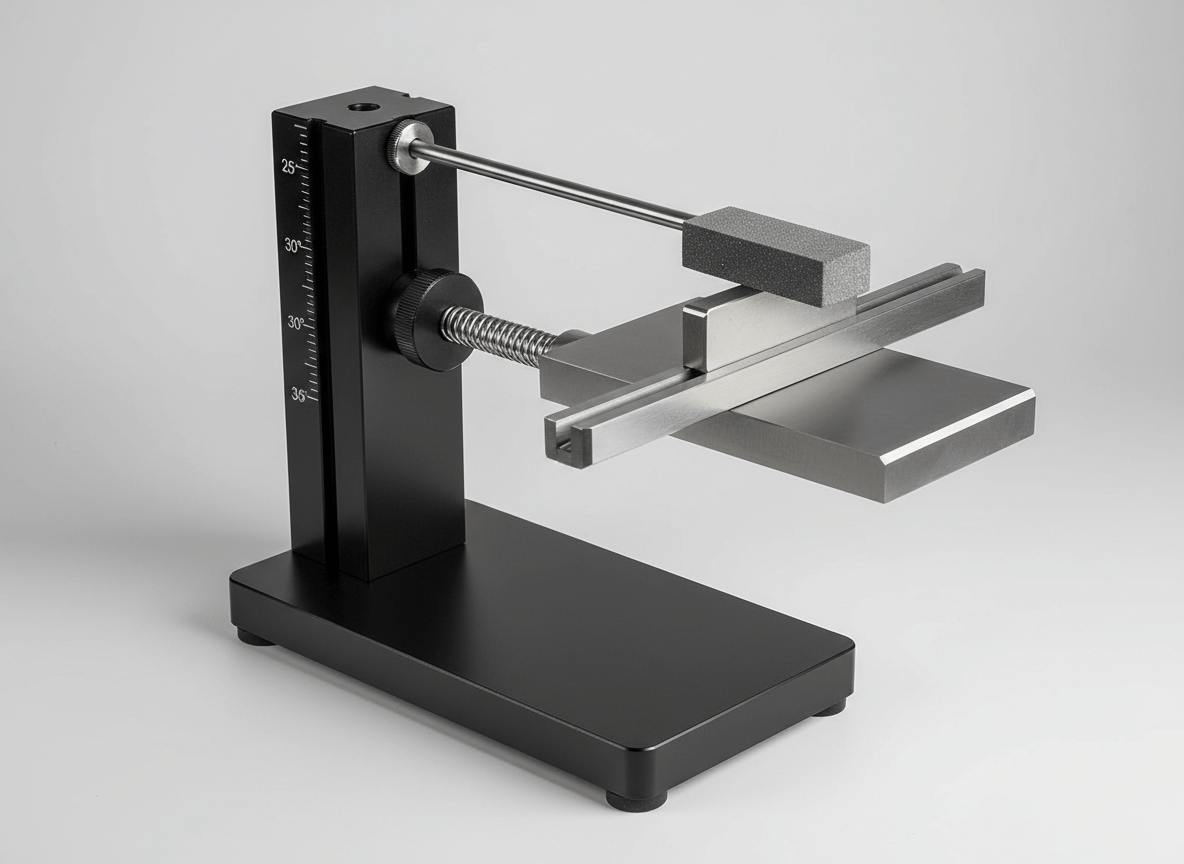
A fixed-angle knife sharpening system is a bench-mounted or portable device that secures a knife blade in a clamp and guides abrasive stones along a calibrated rod at a user-selected angle. Unlike freehand whetstones — which depend entirely on the operator’s consistency — or basic pull-through sharpeners that lock users into a single, uncustomizable angle, a fixed-angle guided system gives the operator full control over edge geometry without demanding years of technique to master.
The core components of any quality fixed-angle knife sharpening system include:
- A clamping mechanism to hold the blade stationary
- A calibrated angle guide, typically adjustable between 12° and 30° per side in 1-degree increments
- Interchangeable abrasive stones progressing from coarse (140–300 grit) through fine (1,000–2,200 grit)
- A rod or arm guide — often utilizing a spherical ball-bearing to eliminate angular deviation
- A stable base with non-slip feet or a bench-mount clamp for safety
How a Fixed-Angle Knife Sharpening System Delivers Consistent Results
The defining advantage of a fixed-angle knife sharpening system over alternative methods is zero angle deviation across the full length of the blade. Traditional sharpening relies on proprioception — the sharpener ‘feeling’ the correct angle. Even experienced professionals drift ±2° to ±5° during a single stroke, which creates micro-facets that dull rapidly under commercial use.
Modern high-end systems address this through spherical bearing rod guides — the rod passes through a pivoting ball bearing, allowing smooth movement while maintaining a mechanically locked angle. The result is an edge geometry that is identical on stroke 1 and stroke 500. For multi-location operations seeking standardized blade quality across properties, this repeatability is operationally significant.
Angle Selection by Knife Application
Edge angle selection is not arbitrary. The following guide applies across most professional contexts:
- 12°–17° per side: Japanese and high-end European chef’s knives requiring thin, razor-like edges for precision slicing
- 17°–20° per side: General-purpose kitchen knives, professional chef’s knives, fillet knives
- 20°–25° per side: Boning knives, hunting blades, utility knives exposed to lateral stress
- 25°–30° per side: Cleavers, bread knives, heavy-duty blades requiring chip-resistant durability
Fixed-Angle Knife Sharpening System vs. Alternative Sharpening Methods
Selecting the right sharpening approach depends on volume, skill level, blade portfolio, and total cost of ownership. The table below compares the major categories:
| System Type | Angle Control | Best For | Typical Cost |
| Guided Fixed-Angle | Precise (±0.05°) | Commercial / Professional | $150–$800+ |
| Pull-Through | Fixed preset | Quick home touch-ups | $15–$60 |
| Whetstone (freehand) | User-dependent | Artisan / enthusiast | $20–$200 |
| Electric Belt | Adjustable guide | High-volume, fast turnaround | $200–$600 |
| Water Cooled Grinder | Jig-dependent | Restoration / industrial | $500–$1,500+ |
For most mid-to-large commercial operations, the fixed-angle knife sharpening system occupies the optimal position: it delivers near-laboratory precision without the mechanical complexity of a Tormek water grinder or the consumable cost of electric belt systems. Entry-level units from Lansky and DMT begin under $80; professional-grade systems from Wicked Edge, Edge Pro, and TSPROF range from $300 to over $800 fully equipped.
The B2B Case: ROI, Compliance, and Total Cost of Ownership
Operational Efficiency
Restaurants and commercial kitchens rely on sharp, well-maintained knives as a baseline for efficient operation and food safety. A fixed-angle knife sharpening system enables in-house blade maintenance on demand — eliminating dependence on third-party sharpening services, which typically charge per knife and require scheduling logistics that disrupt kitchen operations.
Bringing sharpening in-house with a fixed-angle knife sharpening system pays back quickly. A professional-grade system at $400–$800 recoups its cost within months for an operation that previously outsourced sharpening at $3–$8 per knife on a weekly cycle for a 30-knife brigade.
Food Safety and Regulatory Compliance
Food safety regulators and hospitality industry certification programs increasingly mandate regular knife maintenance protocols. Health department inspections in many jurisdictions evaluate knife condition as part of food safety assessments. A documented in-house sharpening schedule using a fixed-angle system — with logged angles per knife — provides verifiable compliance records that third-party services cannot match in specificity.
Blade Lifespan Extension
Over-sharpening and incorrect angle grinding are primary causes of premature blade failure in commercial kitchens. A fixed-angle knife sharpening system limits material removal to what is necessary, at the geometrically optimal angle, extending premium knife lifespan significantly. For operations investing in high-end German or Japanese blades, this directly protects capital expenditure.
Key Procurement Criteria: Choosing the Right Fixed-Angle Knife Sharpening System
When evaluating a fixed-angle knife sharpening system for commercial or institutional deployment, procurement teams should assess the following:
- Look for continuous adjustment (not slotted positions) covering at least 15° to 30° per side, with 1-degree or finer increments.Angle Range and Precision:
- A complete system should include coarse (140–300 grit) for reprofile, medium (400–600) for edge setting, and fine (1,000+) for polish and maintenance.Stone Grit Progression:
- The clamp must accommodate blade widths and spine thicknesses across the operation’s full knife inventory — including wide chef’s knives and narrow fillet blades.Clamp Versatility:
- Ball-bearing rod guides outperform slotted channel guides for angle accuracy. Evaluate play or wobble in the guide mechanism before purchasing.Bearing Quality:
- Modular systems (TSPROF, Wicked Edge) accept expanded stone sets, stropping attachments, and jig upgrades — protecting the investment as needs evolve.Scalability and Accessories:
- CNC-machined aluminum alloy construction is the industry standard for professional-grade units. Verify warranty coverage and availability of replacement parts in North America.Durability and Warranty:
2025 Market Trends Shaping Guided Sharpening Technology
Several converging trends are accelerating adoption of fixed-angle knife sharpening systems across B2B segments in 2025:
- Digital angle indicators are becoming standard on mid-range systems, eliminating mechanical readout ambiguity and enabling precise logging for compliance documentation.
- Diamond abrasive stones now represent 25% of the modern sharpening consumables market, valued for their cutting speed, durability, and compatibility with high-hardness steels above 60 HRC.
- Major hotel chains have begun bulk purchasing commercial sharpeners as part of standardized kitchen equipment packages — a trend that is driving volume pricing negotiations with manufacturers.
- B2B adoption through commercial kitchen suppliers and appliance distributors now constitutes approximately 30% of industrial-grade knife sharpener sales globally, up from an estimated 20% in 2021.
Frequently Asked Questions
Q: How long does it take to sharpen a knife using a fixed-angle knife sharpening system?
A: For a knife requiring full reprofile from dull, expect 10–20 minutes using a coarse-to-fine stone progression. Maintenance sharpening of an already-profiled edge typically takes 3–7 minutes. With practice, staff can manage an entire brigade’s knives in a single service-prep window.
Q: Can a fixed-angle knife sharpening system handle serrated blades?
A: Most systems are designed for straight-edge blades. Some manufacturers — including Lansky and Work Sharp — offer optional serration rods or specialized ceramic rods for edge-touch maintenance on serrated knives, though full serration grinding remains the domain of specialist equipment.
Q: What is the optimal sharpening angle for commercial kitchen knives?
A: Most professional chef’s knives perform best at 17°–20° per side. Japanese knives may call for 15°–17°. Heavy-duty cleavers and bone knives benefit from 22°–25°. Always verify the manufacturer’s recommended factory edge angle before departing from the original geometry.
Q: How does a fixed-angle knife sharpening system compare in total cost to outsourcing sharpening?
A: For a commercial operation outsourcing at an average of $5 per knife, weekly, on a 20-knife brigade, annual spend exceeds $5,000. A professional fixed-angle system at $500–$800 fully equipped typically achieves payback within 8–12 weeks, with ongoing stone replacement as the only consumable cost.
Q: Is staff training required to operate a fixed-angle knife sharpening system?
A: Minimal. Most systems include step-by-step manuals and the clamp-and-guide mechanism eliminates the technique barrier that makes freehand sharpening difficult. A 30-minute orientation is typically sufficient for kitchen staff to achieve consistent, professional-quality results.
Conclusion: Precision Sharpening as a Competitive Operational Advantage
A fixed-angle knife sharpening system is not simply a maintenance tool — it is a productivity investment, a compliance asset, and a capital-protection strategy. In an industry where margins are thin and food safety requirements are non-negotiable, operators who standardize blade maintenance through precision fixed-angle systems gain a measurable edge over those relying on freehand sharpening or external services.
For procurement teams evaluating options, the decision framework is straightforward: assess current sharpening costs, calculate payback period against a quality fixed-angle system, and prioritize units with continuous angle adjustment, diamond-compatible stone compatibility, and modular expandability. The market leaders — Wicked Edge, Edge Pro, TSPROF, KME, and Work Sharp — all offer commercial-grade configurations suited to high-volume professional environments.
As the global knife sharpening equipment market continues its trajectory toward USD 8.8 billion by 2032, fixed-angle knife sharpening systems will remain the benchmark standard for any operation where blade precision, consistency, and total cost of ownership matter.

Hi, this is a comment.
To get started with moderating, editing, and deleting comments, please visit the Comments screen in the dashboard.
Commenter avatars come from Gravatar.