
Tool Grinder Guide

How to Choose the Right Tool Grinder or Universal Tool Sharpening Machine for Your Shop
Quick Answer: The right choice depends on what your shop needs. Specifically, a tool grinder works best for high-volume, repeatable work on one or two tool types. In contrast, a universal tool sharpening machine is better when you sharpen many different tools. Either way, both options cut tooling costs and improve quality.
Why a Tool Grinder Is a Smart Investment for Any Shop
Sharp cutting tools are the base of good production. When tools wear down, quality drops. As a result, scrap rates climb and costs rise.
However, most shops treat tool replacement as a fixed cost. In fact, that is a missed opportunity. In-house tool grinding can cut tooling spend by 50% or more.
The numbers support this. For example, in 2025, the global grinding machine market exceeded USD 6 billion. Moreover, it is growing at 5.4% per year. That growth is driven by makers who want more control over tool quality and cost.
Similarly, the automated tool grinding segment is worth USD 1.5 billion today. Indeed, it is forecast to reach USD 3.1 billion by 2035. As a result, in-house tool care has become a core business strategy, not just a upkeep task.
Therefore, choosing between a tool grinder and a universal tool sharpening machine is one of the most key shop decisions you will make.
What Is a Tool Grinder and How Does It Work?
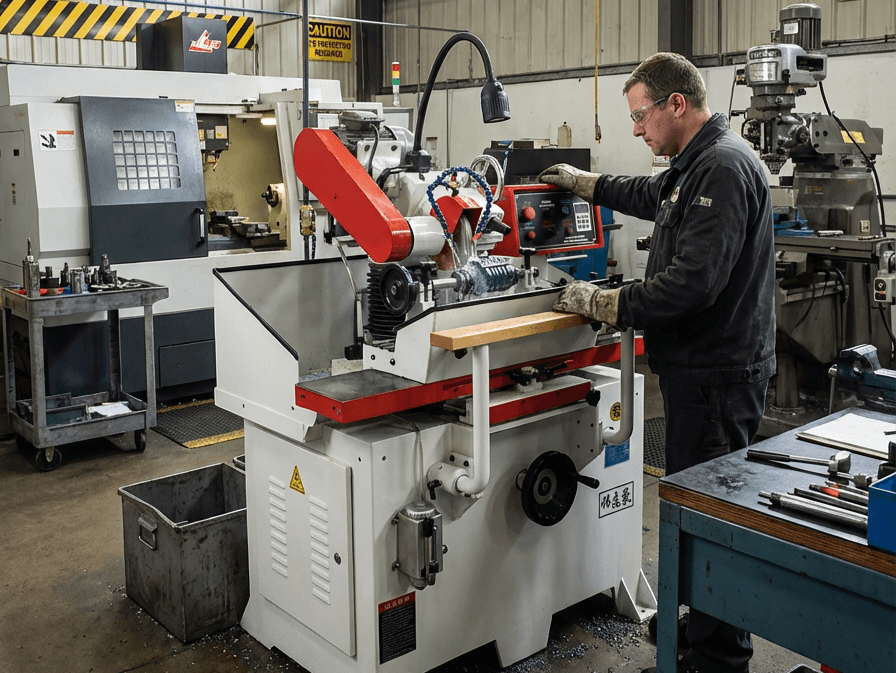
A tool grinder — also called a tool and cutter grinder — sharpens and restores cutting tools. It uses an abrasive wheel on a universal head. Also, fixtures such as vises and headstocks hold the tool at the correct angle.
For example, a tool grinder can handle these common tasks:
- Surface grinding for flat tool faces
- Cylindrical grinding for turned profiles
- Angle grinding for relief and rake faces
- Regrinding of end mills, drills, reamers, taps, and hobs
Manual Tool Grinder vs. CNC Tool Grinder: Key Differences
To start, manual tool grinders need a skilled operator. The operator must know tool shape and wheel selection. However, they are cost-effective for low-volume or custom jobs.
CNC tool grinders, on the other hand, are built for high-volume work. In fact, five-axis models are the current standard. For example, they use touch probes or laser sensors to measure tools on their own. So, they hold specs below 5 micrometers with no manual setup needed.
In 2025, five-axis CNC tool grinders held a 42% market share in the automated grinding segment. Therefore, they remain the top choice for precision work.
What Is a Universal Tool Sharpening Machine?
A universal tool sharpening machine is built for one purpose: flexibility. In fact, it can sharpen many different tool types on one platform. Moreover, it goes far beyond what a basic bench grinder can do.
Specifically, the key feature is a rotating, adjustable workhead. It places tools at almost any angle — both side to side and up and down. As a result, one machine covers a very wide range of tool shapes.
For instance, a universal tool sharpening machine can sharpen all of these:
- Twist drills and step drills (HSS and carbide)
- End mills — flat, ball-nose, 2 to 6 flute
- Milling cutters, side mills, and face mills
- Reamers, countersinks, and boring bars
- Lathe turning tools and threading tools
- Circular saw blades and profile tools
Also, the biggest advantage is breadth. For instance, if your shop uses many tool types and diameters, one machine handles them all. As a result, you avoid buying several single-purpose sharpeners. This saves money and floor space.
Tool Grinder vs. Universal Tool Sharpening Machine: Side-by-Side
Use the table below to compare both options. These are the criteria that matter most to buyers. In particular, look at cost, tool range, and operator skill.
| Feature | Tool Grinder | Universal Tool Sharpening Machine |
| Primary use | Precision grinding of specific tool geometries | Resharpening a wide variety of cutting tools |
| Best for | Production shops and tool manufacturers | Job shops and mixed-tool upkeep departments |
| Axis count | 4–6 axes (CNC models) | 3–5 axes with universal workhead rotation |
| Automation | Manual to fully CNC-automated | Mainly manual; semi-automatic available |
| Tool range | Specialized: end mills, drills, inserts | Broad: drills, mills, reamers, taps, lathe tools |
| Operator skill | Moderate to high — CNC code required | Moderate — fixture and accessory knowledge needed |
| Investment | USD $10,000 – $150,000+ | USD $2,000 – $50,000 |
| Throughput | High-volume, repeatable | Low-to-medium volume, highly flexible |
5 Key Criteria for Choosing the Right Tool Grinder
1. How Much Volume Does Your Tool Grinder Need to Handle?
First, think about your volume. If your shop runs the same tool type in large numbers, a CNC tool grinder is the right fit. It delivers the speed and consistency you need.
However, if you sharpen tools now and then, or across many types, a universal tool sharpening machine is more practical. It covers more ground at a lower cost.
2. How Many Different Tool Types Do You Sharpen?
Second, count the different tools in your shop. If you use drills, turning tools, milling cutters, and reamers, then flexibility matters. In that case, a universal tool sharpening machine removes the need for multiple machines.
As a result, your capital cost drops and your floor space stays free for output.
3. What Precision Level Does Your Tool Grinder Need to Reach?
Third, think about your specs. Aerospace, medical, and mold work demand the tightest specs. Only a CNC tool grinder can hit that level of accuracy at scale.
For general machining, fab work, or upkeep tasks, however, a universal tool sharpening machine is more than good enough. Therefore, you do not need to overspend on precision you will not use.
4. What Are Your Operators’ Skills?
Fourth, assess your team. A universal tool sharpening machine needs operators who know tool shapes and fixture setup. A CNC tool grinder, on the other hand, puts that knowledge into machine code.
Similarly, both options need some training. Therefore, factor in training time and cost before you decide.
5. What Is the Total Cost of Your Tool Grinder Investment?
Finally, look beyond the purchase price. Entry-level universal tool sharpening machines start at around USD $2,000. Industrial versions range from USD $10,000 to $50,000.
In contrast, CNC tool grinders from brands like ANCA, Walter, and Rollomatic cost USD $50,000 to over $150,000. Also, you must budget for wheels, fixtures, coolant, and training. As a result, the true cost is often much higher than the sticker price.
Grinding Wheel Selection for Your Tool Grinder or Sharpening Machine
The grinding wheel is just as key as the machine itself. Using the wrong wheel will damage tools and wear out fast. Therefore, you must match the wheel to the tool material.
- Aluminum oxide wheels: Good for HSS tools and general use
- CBN (cubic boron nitride) wheels: Best for hard steels and high-alloy tools
- Diamond wheels: Required for carbide tooling, ceramic inserts, and PCD tools
- Silicon carbide wheels: Used for non-ferrous metals and cast iron
For example, when you set up a universal tool sharpening machine for carbide tools, always check for diamond or CBN wheel support. Similarly, coolant matters. Good coolant controls heat and keeps tool hardness intact.
Frequently Asked Questions About Tool Grinders
Q: What is the difference between a tool grinder and a universal tool sharpening machine?
A: A tool grinder sharpens cutting tools. A universal tool sharpening machine is a specific type that uses a multi-angle workhead and a full fixture set. As a result, it can sharpen many tool types — drills, mills, reamers, and more — with one machine.
Q: Can a universal tool sharpening machine replace a CNC tool grinder?
A: For most job shops, yes. A universal tool sharpening machine provides good accuracy and wide coverage. However, if your shop needs tight specs at high volume, a CNC tool grinder is still the better choice.
Q: How do I know when a tool needs regrinding instead of replacement?
A: Watch for higher cutting force, poor surface finish, or visible edge wear. In addition, tool chatter is a common sign. Carbide tools can usually be reground 3 to 5 times before they can no longer be restored.
Q: What grinding wheel do I need for carbide tools?
A: Diamond wheels are required for carbide. Before you buy, confirm that your tool grinder or universal tool sharpening machine is rated for diamond wheels. Also check that the spindle RPM matches the wheel’s speed rating.
Q: Is in-house tool sharpening worth it for smaller shops?
A: In most cases, yes. Shops that send out 20 or more tools per month often recover the cost of a universal tool sharpening machine within 12 to 24 months. Also, in-house sharpening cuts lead times and brings tools back to like-new form.
Conclusion: Match the Tool Grinder to Your Shop’s Needs
The choice between a tool grinder and a universal tool sharpening machine comes down to your shop’s needs. For high-volume work with tight specs, a CNC tool grinder is the right pick. For job shops with a wide mix of tools, a universal tool sharpening machine offers better value.
Therefore, start by checking your tool list and monthly sharpening volume. Then talk to machine sellers about fixture options, wheel support, and training. As a result, you will find the machine that pays for itself — in savings, quality, and day-to-day output.
Need a machine quote? Send your blade type, size range, production needs, and destination country by WhatsApp, or use Contact Weizhihao. Machine videos are available on YouTube.
